Service Accounts
What are service accounts?
Service Accounts are used for Machine to Machine (M2M) authentication. They allow automated systems like CI/CD pipelines to authenticate and interface with Tharsis.
Service accounts allow the Tharsis CLI to be directly integrated into a CI/CD pipeline.
Check the FAQ to see if there's already an answer.
Authentication methods
Service accounts support two authentication methods:
- OIDC Federation - Uses OIDC trust policies to verify tokens from identity providers (e.g., GitLab CI, GitHub Actions)
- Client Credentials - Uses a client ID and secret for direct authentication
You can enable one or both methods on a service account.
Create a service account
-
Navigate to the target group's page and click on the
Service Accountstab. Click on theNEW SERVICE ACCOUNTbutton. -
Fill in the required fields:
- Name: A unique name for the service account
- Description (optional): A description of the service account's purpose
-
Configure at least one authentication method:
For OIDC Federation:
- Add one or more OIDC trust policies with:
- Issuer URL (e.g.,
https://gitlab.com) - Bound claims to verify (e.g.,
namespace_path,project_id)
- Issuer URL (e.g.,
For Client Credentials:
- Check "Enable client credentials"
- Optionally set an expiration date (1 day to the configured maximum, defaults to the maximum)
- Important: Copy the client ID and secret when displayed - the secret is only shown once
- Add one or more OIDC trust policies with:
-
Add the service account as a member to a group or workspace:
-
Navigate to the group or workspace where this service account will be used and head to the
Memberspage on the left and click onADD MEMBER: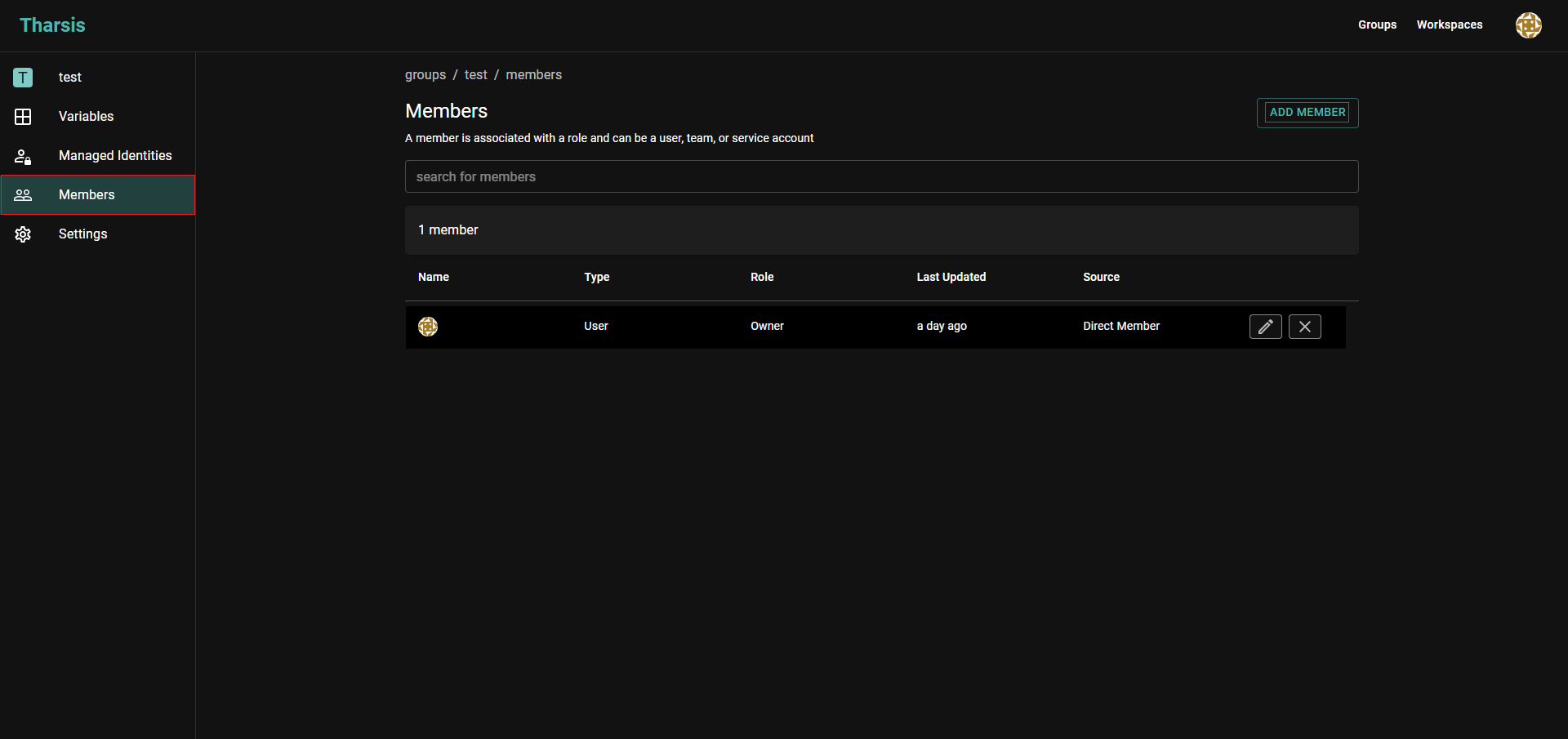
-
Click on
Service Accountin theAdd Memberpage: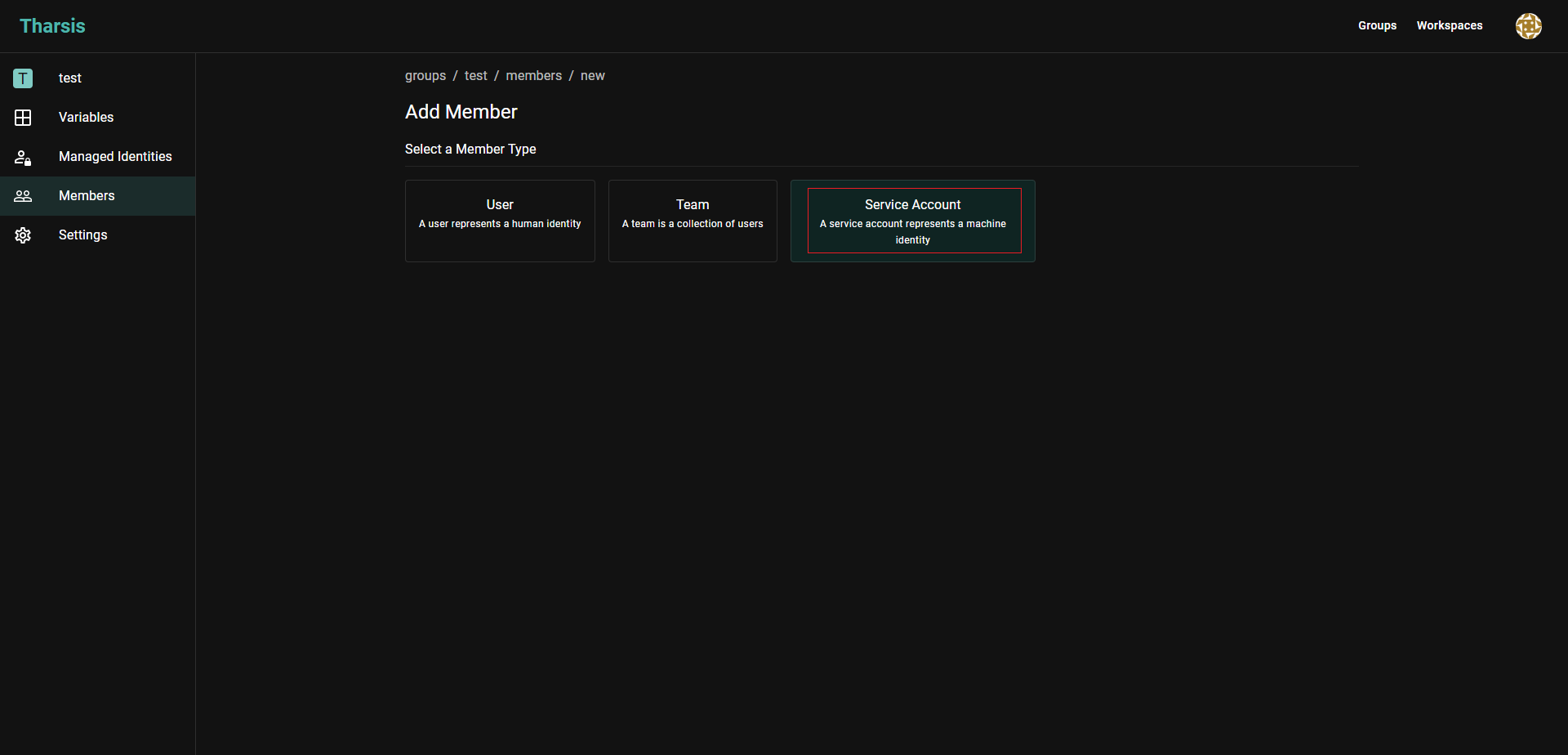
-
Click on the
Service Accountfield and select the appropriate service account that was just created, a role, and clickADD MEMBER: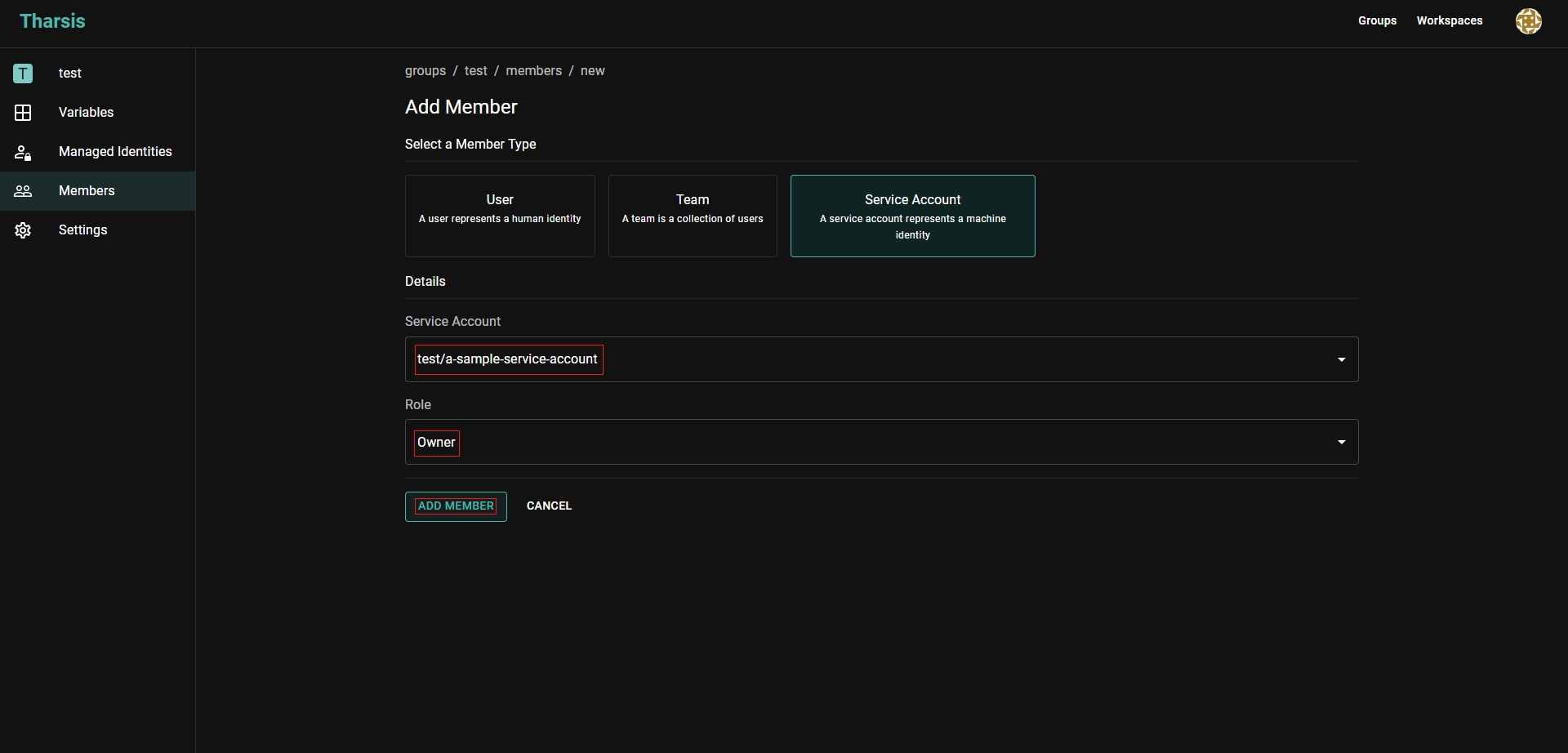
-
View service account details
After creating a service account, click on it to view its details. The details page has two tabs:
- OIDC Federation - Shows configured trust policies with their issuers and bound claims
- Client Credentials - Shows whether client credentials are enabled and when the secret expires
Using client credentials
Client credentials provide a simpler authentication method that doesn't require an external identity provider.
Obtaining a token
Make a POST request to the token endpoint:
curl -X POST https://your-tharsis-instance/v1/serviceaccounts/token \
  -d "grant_type=client_credentials" \
  -d "client_id=YOUR_CLIENT_ID" \
  -d "client_secret=YOUR_CLIENT_SECRET"
Response:
{
  "access_token": "eyJhbGciOiJSUzI1NiIs...",
  "token_type": "Bearer",
  "expires_in": 300
}
Use the access_token as a Bearer token in the Authorization header for subsequent API requests.
Secret expiration
Client secrets expire after a configurable period. The maximum expiration is configured by your Tharsis administrator (default: 90 days). You'll receive email notifications 7 days before expiration if you have the "Service Account Secret Expiration" notification preference enabled.
To reset an expiring or compromised secret:
- Navigate to the service account details page
- Click "Reset Client Credentials"
- Optionally set a new expiration date
- Copy the new client secret - it's only shown once
Resetting credentials immediately invalidates the old secret. Update all systems using the old credentials before or immediately after resetting.
Update a service account
To update a service account, navigate to the "Service Accounts" page, select the service account you want to update, and click on the "Edit" button.
You can update:
- Description
- OIDC trust policies (add, modify, or remove)
- Client credentials (enable or disable)
When enabling client credentials on an existing service account, the client ID and secret will be displayed once. Make sure to copy them.
Click Update Service Account to save the changes.
Delete a service account
To delete a service account, navigate to the "Service Accounts" page, select the service account you want to delete, and click on the upside-down caret next to the "Edit" button. Then click on the "Delete Service Account" button.
Deleting a service account will break any integrations that rely on it, such as CI/CD pipelines.
Assigning Roles to a Service Account
After creating a service account, you can assign roles to it. Navigate to the target group or workspace page and click on the "Members" tab. Then click on the "Add Member" button.
Select "Service Account" from the options and search for the service account you want to assign a role to. Then select the role you want to assign to the service account and click Add Member. Generally, a deployer role is sufficient for most use cases.
Without a role, the service account will not be able to access any resources in the group or workspace.
Frequently asked questions (FAQ)
Who can create / update / delete service accounts?
Deployer or higher roles can create a service account.
How do I use a service account with the Tharsis CLI?
See the CLI documentation for more information.
Why is my service account not working?
Please make sure that the service account is a member of the group or workspace and has the necessary role assigned to it. Also, ensure that the service account has the correct authentication configuration:
- For OIDC: verify the Identity Provider information and bound claims
- For client credentials: verify the client secret hasn't expired
What are bound claims?
Bound claims are used to verify the JSON Web Token (JWT) that is issued by the Identity Provider against the service account upon login. Some common claims are aud, sub, namespace_path, job_id, etc., depending on the Identity Provider.
What is the difference between OIDC and client credentials authentication?
- OIDC Federation: Requires an external identity provider (like GitLab or GitHub) to issue tokens. Best for CI/CD pipelines where the platform provides OIDC tokens.
- Client Credentials: Uses a client ID and secret directly with Tharsis. Simpler setup but requires secure storage of the client secret.
When should I use client credentials vs OIDC?
Use OIDC when:
- Your CI/CD platform supports OIDC tokens (GitLab CI, GitHub Actions, etc.)
- You want to avoid storing long-lived secrets
- You need fine-grained control over which jobs can authenticate
Use client credentials when:
- Your system doesn't support OIDC
- You need a simpler authentication setup
- You're integrating with custom tooling or scripts
How do I rotate client credentials?
Use the "Reset Client Credentials" button on the service account details page. This generates a new client secret and invalidates the old one immediately.
What happens when my client secret expires?
The service account will no longer be able to authenticate using client credentials. You'll need to reset the credentials and update any systems using the old secret. Enable the "Service Account Secret Expiration" notification to receive warnings 7 days before expiration.
Should I just give my service account an owner role?
No, it is not recommended to give a service account an owner role. Generally, a deployer role is sufficient for most use cases. An owner role will allow the service account to manage the group, its members, and arbitrarily perform any action within the namespace. This goes against the principle of least privilege.
Can a service account from one group access resources in another group?
No, a service account can only access resources within the group it is a member of.
Will the CLI periodically renew the token for the service account?
Yes, the CLI will periodically renew the token for the service account. The token should be renewed a short period of time before it expires.